


For decades, the Caribbean diaspora has been an important source of financial support for the region. Remittances, property purchases, family support and business activity connect millions of Caribbean nationals overseas to the economies they still consider home.
But there is a larger opportunity.
How can the Caribbean create credible pathways for its diaspora to become investors, owners and long-term partners in regional growth?
That question sits squarely within the wider investment conversation at the Caribbean Investment Forum 2026, taking place in Barbados from October 5–7. CIF2026 is designed to connect investors with credible Caribbean opportunities, strengthen investor confidence and move conversations closer to transactions.
Across the Caribbean, businesses are seeking capital to scale, entrepreneurs are developing new products and services, and governments are seeking private investment in areas including renewable energy, food security, digital transformation, logistics and infrastructure.
Many of those opportunities will be on display at CIF2026, where investors will see projects seeking capital across digital transformation, sustainable agriculture, logistics, health technology, climate resilience and the green economy. Among those being showcased are a US$5 million cross-border digital payments platform, a US$3.5 million solar-powered vertical farming platform, a US$3 million regenerative agriculture venture and a US$4 million soursop-led agricultural estate and processing project.
The opportunity is not to replace remittances. These flows remain critically important to households and economies across the Caribbean.
Rather, the challenge is to create additional pathways for diaspora participation through investment and ownership.
David Mullings, Chairman and CEO of Blue Mahoe Capital, argues that the fundamental barrier is neither a lack of capital nor a lack of viable opportunities.
“The Caribbean does not have a shortage of capital, nor is there a shortage of credible, investment-ready opportunities. Access is the problem.”
According to Mullings, international investors already find opportunities across the region, but Caribbean diaspora communities have not historically been approached in the same way.
“Foreign investors come to the region and have no issues with deal flow. The Caribbean diaspora has never been targeted in the same way, and no one has really tried to give us in the diaspora the structures that we want.”
That distinction is important.
Many Caribbean nationals living overseas are still expected to open accounts in individual Caribbean jurisdictions and invest through local institutions and markets. For diaspora investors accustomed to the regulatory environment, platforms and financial products available in countries such as the United States, Canada or the United Kingdom, that may not be the most accessible route.
The opportunity, Mullings argues, lies in creating structures that allow diaspora investors to participate in Caribbean growth from the markets in which they now live.
Access, however, is only one part of the equation. Investor confidence is equally important.
Mullings says negative experiences with both regulated and unregulated investment schemes have created a lingering trust deficit among parts of the Caribbean diaspora.
“The Caribbean diaspora has low trust when it comes to investing back home due to failed investment schemes, the inefficiencies in opening investment accounts in the region, and the lack of regulated investment vehicles in their new home countries that make it easy to invest transparently back home and have liquidity.”
His view is that the solution requires regulated investment vehicles in diaspora markets, capable and trusted management, strong regional partnerships and greater transparency.
The issue is not simply encouraging the diaspora to invest. It is creating investment structures that people understand, trust and can access from where they live.
New models are beginning to emerge.
At the Caribbean Investment Forum 2025, Mullings spoke about the need to create more accessible pathways through which investors could participate in Caribbean opportunities.
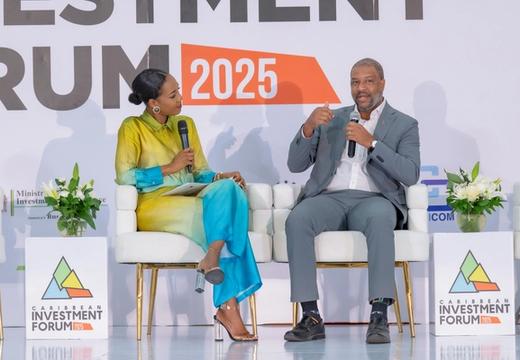
Since then, Blue Mahoe Capital Caribbean has launched a U.S.-based Regulation Crowdfunding offering designed to give retail investors, including members of the Caribbean diaspora, regulated access to Caribbean-focused investment opportunities.
The company’s initial focus is residential development in Jamaica, illustrating one emerging model for converting diaspora interest into structured investment.
For Mullings, however, the experience has also reinforced how deeply trust and familiarity influence investment decisions.
“Even with a NASDAQ ticker symbol reservation, appearances on Bloomberg TV and NASDAQ TradeTalks, the offering has been met with skepticism about investing back home because of the bad experiences so many have had.”
It has also revealed another challenge: financial literacy.
Mullings says many diaspora investors are more comfortable with real estate than with investment products such as equities or private equities because property feels tangible and easier to verify.
“They trust real estate more because they can call their cousin to verify that the deal is real and trust block and steel in the ground because they can see it, feel it and touch it.”
As Mullings puts it:
“There is a financial literacy hurdle to overcome in order to move the Caribbean diaspora into additional asset classes.”
The region already has a compelling investment story.
Opportunities exist across sectors aligned with major global priorities, from renewable energy and climate resilience to food security, technology, logistics, housing and modern infrastructure.
The challenge is ensuring those opportunities are visible, accessible, and investible.
Governments, investment promotion agencies, financial institutions and the private sector therefore all have roles to play strengthening project preparation, improving the quality of investment information, developing suitable financing mechanisms and communicating opportunities consistently to potential investors.
CIF2026 will feature the session “The Global Investment Outlook: Where Capital Is Moving Next and Why the Caribbean Must Be Ready,” focused on how global investors assess emerging markets and what the Caribbean must do to strengthen competitiveness and investor readiness. Meanwhile, “Inside the Investment Decisions: What Makes Investors Say Yes?” will examine how investors assess businesses, founders, governance, scalability, financial performance, risk and market potential, the very issues that determine whether interest converts into capital.
For the Caribbean diaspora, the next chapter of engagement can therefore be about more than how much money is sent home.
It can also be about how much is invested, how much ownership is created, and how many Caribbean businesses and projects are able to grow as a result.
The relationships already exist.
The challenge now is to build trust, access, and investment structures that can turn those relationships into capital.
Caribbean Investment Forum 2026
October 5–7, 2026 | Barbados
Invest. Innovate. Accelerate.
