


As the global community marks Global Goals Week, it is an important moment to reflect not only on the partnerships needed to advance the Sustainable Development Goals, but also on how we determine whether those partnerships are delivering meaningful results.
SDG 17: Partnerships for the Goals recognises that sustainable development cannot be achieved by institutions working in isolation. Progress depends on cooperation, bringing together governments, development institutions, the private sector and other partners around shared priorities, resources and expertise.
For Caribbean Export, this principle has been central to the Agency’s work for three decades.
As the Agency marks its 30th anniversary in 2026, its evolution has been shaped by partnerships that have helped strengthen the Caribbean private sector, expand opportunities for businesses and support regional economic development.
Among the most significant has been Caribbean Export’s longstanding partnership with the European Union, which has supported the Agency and Caribbean private sector development throughout its 30-year journey. Alongside this relationship, collaboration with institutions including the Inter-American Development Bank, Global Affairs Canada, the Caribbean Development Bank and others continues to enable the development of programmes and initiatives responding to the needs of businesses across the region.
Partnerships can mobilise resources, bring together expertise and turn shared priorities into tangible programmes.
But they also raise an equally important question:
What changed because the work was done?
That question came into particularly sharp focus recently at the Caribbean Development Bank’s Caribbean Evaluation Space in Barbados.
CDB President Daniel Best captured the challenge simply:
“Evidence is not optional, it is essential.”
It is a statement that goes to the heart of effective development work.
Implementing a project is not, by itself, evidence of success. Nor is completing a series of planned activities or meeting implementation targets.
The real test is whether an intervention ultimately delivers better results for the people, businesses and communities it was designed to serve.
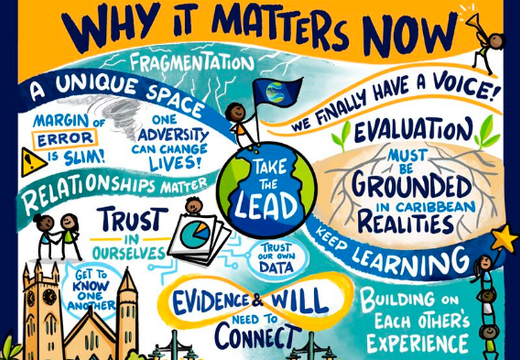
That requires institutions to look beyond outputs and ask more difficult questions.
Did the programme create the intended change? Who benefited? Were some groups affected differently from others? Was the approach appropriate to the problem? Did the intervention deliver sufficient value from scarce development resources? And, importantly, what should be done differently if the evidence shows that the expected results were not achieved?
This is where evaluation becomes much more than a compliance requirement.
It becomes a strategic management tool.
One of the most valuable messages from the Caribbean Evaluation Space was the importance of creating a stronger culture of learning, adaptation and accountability across development institutions.
Evidence should give decision-makers the confidence to continue what is working, adjust what is not and allocate resources where they can deliver the greatest impact.
For me, this is also what makes the monitoring, evaluation and reporting aspect of development work particularly interesting.
I may be something of a secret data geek, but there is real value in being able to move beyond instinct and examine what the evidence is telling us.
Whether assessing the results of a development programme, the effectiveness of a partnership or even the performance of a communications campaign, data allows us to ask whether the activity achieved what it was intended to achieve and then make better decisions based on that information.
It also reinforces another important point raised during the Evaluation Space:
If the result is not what we expected, what are we going to do about it?
There is little value in measuring performance if the findings do not lead to action.
If an evaluation identifies a weakness and nothing changes — no adjustment in programme design, targeting, implementation or resource allocation — then the exercise risks becoming another box checked rather than an opportunity to improve.
Failing to act also has a cost.
This is particularly important in the Caribbean, where development resources are finite and the challenges facing our economies are significant. Every programme, partnership and investment must therefore be approached with a clear understanding of its purpose, the problem it is seeking to address, who stands to benefit and how success will ultimately be measured.
An equity lens is equally important. Development impact cannot only be assessed at the aggregate level. We also need to understand who benefits, who may be left behind and whether particular groups are disproportionately affected.
In many ways, this brings the conversation back to SDG 17.
Partnerships create possibilities. Evidence helps us determine whether those possibilities translate into progress.
Partnerships mobilise resources. Evaluation helps establish whether those resources are generating value.
Partnerships bring organisations together around common objectives. Monitoring and learning help ensure that those objectives ultimately translate into meaningful change.
This thinking is also highly relevant as Caribbean Export prepares to convene the Caribbean Investment Forum 2026 in Barbados from October 5–7.
CIF itself is built on partnership.
Caribbean Export is working alongside the Government of Barbados and the European Union, together with institutions including the Inter-American Development Bank, Republic Bank and other regional and international partners, to bring investors, businesses, policymakers and development institutions together around a pipeline of Caribbean investment opportunities.
These partnerships help create the platform.
But the event itself is not the ultimate outcome.
The real impact will be measured by what happens because those connections were made.
Do Caribbean businesses access the capital they need to scale? Do investment projects progress? Do conversations between investors and project owners develop into partnerships and transactions? Do those investments ultimately contribute to employment, innovation, resilience and wider economic opportunity across the Caribbean?
The work does not end when the Forum closes.
Capturing investor interest, following the progress of projects, understanding where opportunities advance or stall and learning from those outcomes will be essential to understanding CIF’s longer-term impact.
That is perhaps the clearest connection between the conversations taking place during Global Goals Week, the lessons emerging from the Caribbean Evaluation Space and the work of institutions such as Caribbean Export.
Partnership. Action. Evidence. Learning. Impact.
Thirty years of Caribbean Export’s work demonstrates what sustained partnerships can make possible.
The next challenge is ensuring that we continue to ask the harder question:
What difference did those partnerships ultimately make?
As we work towards the Sustainable Development Goals, progress will depend not only on our ability to build partnerships, but on our willingness to measure their impact, learn from the evidence and act on what it tells us.
Because partnerships are powerful.
But the real measure of their value is the change they help to create.
