


Social entrepreneurs across the Caribbean now have a new resource to help them navigate the region's social innovation landscape, access support and turn promising ideas into sustainable ventures.
The Guide was developed under the EU-LAC Social Accelerator, a flagship programme of the European Union's Inclusive Societies Initiative. The programmeseeks to reduce inequalities and strengthen social cohesion across Europe, Latin America and the Caribbean by supporting social innovation and entrepreneurship. It is implemented through a consortium of six partners, led by CAINCO from Bolivia and Caribbean Export is responsible for implementation in the Caribbean.
Making Waves draws on an ecosystem mapping exercise conducted in Barbados, Dominican Republic, Jamaica and Trinidad and Tobago. The exercise identified more than 180 actors involved in social innovation and provided insights into the opportunities, challenges and support systems shaping the sector.
The mapping revealed three significant gaps: innovators frequently operate in isolation, with limited awareness of others working in the sector; access to financing and institutional support remains a challenge; and newcomers often struggle to navigate the ecosystem while developing ventures that are both commercially viable and socially impactful.
Speaking at the launch, Leo Naut, Deputy Executive Director of Caribbean Export, explained that the Guide was developed to make the region's social innovation ecosystem more visible and accessible while providing practical support to those seeking to enter or invest in the sector.
“What we wanted to do was create a guide that potential investors could use to identify who is working on social innovation across the Caribbean. We also wanted it to serve as a resource for newcomers, breaking down the information into actionable steps that can help them develop and advance their ventures,” Naut said.
Among the major findings contained in the guide are the significant contribution of women to social innovation and the growing involvement of young entrepreneurs.
“When you read the Guide, you will see just how significant women's role in social innovation is. I'm particularly excited that 60% of social purpose groups in Barbados are led by women. We're also seeing more young people developing social enterprises that are not only profitable, as demonstrated by the pitches we've heard here today, but also create meaningful social impact,” Naut added.
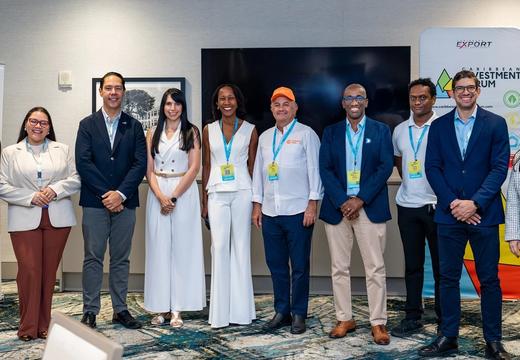
The launch was preceded by a showcase of social innovation in practice, as four winners of the EU-LAC Social Accelerator Pitch Competition presented their businesses to investors and other stakeholders participating in a masterclass titled “Building the Caribbean’s Next Generation Investment Ecosystem”.
The entrepreneurs represented Barbados, the Dominican Republic, Jamaica and Trinidad and Tobago, with solutions spanning heritage tourism, financial inclusion and healthcare innovation.
From the Dominican Republic, Colmado Cash presented its digital solution designed to modernise informal credit arrangements used by neighbourhood shops, known as colmados. Co-founder Diego Torres highlighted the value of the programme's mentoring and pitch preparation in helping the company communicate both its business model and social impact to potential investors. He also pointed to the opportunities created through CIF to establish relationships that could support the company's growth.
Dolphin, a Trinidad and Tobago healthcare technology venture working to improve access to affordable medication, was represented by Gerard Thomas, Chief Executive Officer, who highlighted the potential for partnerships with public institutions and development organisations to expand the company's impact.
“Why I'm excited too, is the opportunity to connect with persons from government and development agencies to see how we can create an impact, not just at the consumer level, but also at the country level, and how Dolphin can be a tool to help governments, particularly in reducing healthcare costs,” Thomas said.
Byde Mill – The Experience, a Barbados-based tourism and heritage platform, was represented by Renee Coppin, General Manager. She said one of her biggest takeaways was recognising the interest in businesses that create value beyond financial returns.
“I think that is important because a lot of what we do is very extractive. It is important that the businesses we develop are sustainable and ultimately benefit the communities in which they operate,” Coppin said.
Representing Jamaica, EleCare AI showcased its artificial intelligence-enabled electronic health records solution. Dr. Franco Pencle, CEO and Founder, described the value of CIF in raising awareness of the company's work and creating connections with potential investors and partners.
“It has already been a launchpad for persons to see the work that we're doing, and it connects us with investors and like-minded individuals around the region in one simple space,” he said.
Together, the four ventures demonstrated the diversity of social innovation emerging across the Caribbean and the potential for businesses to address pressing regional challenges while building commercially sustainable operations.
The Guide is available exclusively in digital format in both English and Spanish and is intended to serve as a living resource that can be updated as new information, organisations and opportunities emerge across the Caribbean's social innovation ecosystem.
Caribbean Export encourages innovators, investors, business support organisations and development partners to explore the Guide and contribute to building a more visible, connected and supportive environment for social innovation across the region.
Access Making Waves: A Caribbean Social Innovation Guide:
https://carib-export.com/en/projects/eu-lac-social-accelerator