


Women-led enterprises represent an undercapitalised growth opportunity for the Caribbean. At CIF 2026, investors, entrepreneurs and development finance leaders challenged the region to rethink how capital is mobilised and what it will take to turn women's entrepreneurial ambition into economic growth.
What if the challenge facing women-led businesses in the Caribbean is not simply their readiness for investment, but the readiness of the investment ecosystem to recognise and finance their potential?
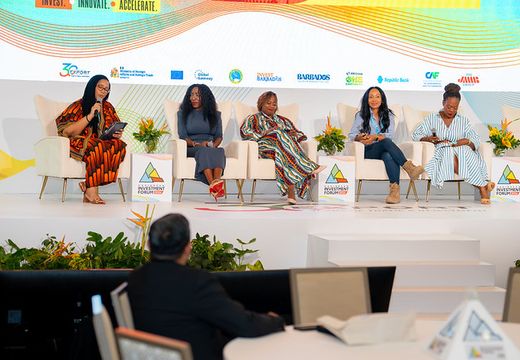
That question was at the heart of "The Gender Dividend: Investing in Women-Led Caribbean Businesses as the Next Growth Market", a discussion at the Caribbean Investment Forum (CIF) 2026 in Barbados.
Moderated by Teocah Dove of the Caribbean Export Development Agency, the session brought together representatives from 2X Global, the Caribbean Development Bank (CDB), and experienced investors and entrepreneurs to explore the commercial case for investing in women-led businesses and the changes needed to unlock greater capital flows.
The conversation moved beyond familiar discussions of the barriers women face, focusing instead on growth, competitiveness, investment readiness and the institutional changes required to create meaningful opportunities.
An overlooked investment opportunity
Setting the stage through a virtual keynote, Jessica Espinoza, CEO of 2X Global, highlighted a striking disconnect in global investment patterns.
Despite the commercial potential of women-led enterprises, all-female founding teams receive approximately 2% of global venture capital. Yet research cited by Espinoza suggests that businesses founded or co-founded by women can generate more than twice as much revenue per dollar invested.
The implication is significant: women-led businesses are not simply a development priority but an undercapitalised growth market.
Espinoza challenged investors to reconsider how opportunities are identified and evaluated. Rather than focusing exclusively on whether women entrepreneurs are investment-ready, financial institutions must also examine whether their networks, products and assumptions about risk allow them to recognise promising businesses.
Amanda Lynch-Foster of 2X Global reinforced this perspective, explaining that gender-lens investing extends beyond financing women-owned enterprises. It also considers women's participation in leadership, employment and supply chains, as well as businesses delivering products and services that benefit women.
This broader approach creates opportunities to direct capital into enterprises capable of delivering both competitive financial returns and meaningful economic impact.


What investors really want to see
While the investment ecosystem must evolve, the panellists were equally clear that entrepreneurs need to approach capital raising strategically.
Investor and entrepreneur Toni Thorne offered a practical starting point: Does your business actually need an investor?
Not every business requires equity financing. Some may benefit more from loans, grants, advisory support or reinvesting profits. Bringing an investor into a business introduces expectations around performance, returns and ownership that entrepreneurs must fully understand.
Thorne also stressed the importance of financial literacy. Entrepreneurs must know their numbers, understand their valuation and confidently articulate the commercial proposition behind their businesses.
Angela Rainford, who has raised capital across multiple rounds for renewable energy and infrastructure ventures, brought this message to life through her own experience.
Reflecting on a conversation with one of her investors, Rainford explained that the decision to invest was driven primarily by the strength of her business, her track record, the potential returns and the risks involved.
While acknowledging that gender bias can influence some investment decisions, she encouraged women entrepreneurs not to underestimate their capabilities or allow anticipated rejection to define their approach.
Having successfully raised capital on several occasions, Rainford emphasised that credibility is strengthened through execution. Delivering results builds investor confidence and makes subsequent fundraising easier.
She also offered an important reminder that rejection is part of the entrepreneurial journey. Understanding why an investor says no can provide valuable lessons for improving the next pitch.
Making the financial ecosystem work differently
Beyond individual businesses, the discussion examined the responsibility of financial institutions to address structural barriers that restrict capital flows.
Lisa Harding of the Caribbean Development Bank highlighted the role multilateral development banks can play in reducing investment risk and encouraging private capital to enter underserved markets.
Through guarantees, co-financing arrangements and other risk-sharing mechanisms, development finance institutions can help make opportunities more attractive to commercial investors.
CDB is also partnering with 2X Global to develop practical resources and case studies that will help Caribbean financial institutions integrate gender-lens considerations into their investment decisions and financial products.
The importance of catalytic finance was further illustrated by Lynch-Foster, who shared how a US$750,000 grant from 2X Global's Resilient Futures Fund helped unlock an additional US$4 million in investment for a women-focused investment vehicle serving Latin America and the Caribbean.
The example demonstrated how relatively modest interventions can help mobilise significantly greater financing.
However, an important challenge emerged during the audience discussion: the "missing middle" in Caribbean business financing.
Entrepreneurs seeking US$500,000 or US$1 million can find themselves caught between small enterprise lending programmes and institutional investors seeking much larger transactions.
The panellists acknowledged that this gap remains difficult to address, reinforcing the need for more diverse investment mechanisms, stronger investor networks and financing options suited to businesses at different stages of development.


Training is not the destination
Perhaps one of the most important messages for regional development institutions came from Harding, who challenged the tendency to measure entrepreneurship support primarily through training and capacity-building activities.
"Training is not the destination."
Completing a workshop or business development programme does not automatically translate into commercial success.
The real opportunity lies in connecting entrepreneurs with buyers, procurement opportunities, investors and markets where their businesses can grow.
Harding highlighted CDB's efforts to help women-led enterprises better understand and access procurement opportunities, while calling for stronger links between business development initiatives and tangible commercial outcomes.
This message resonates with Caribbean Export's ongoing work through the Global Affairs Canada-funded Caribbean Women Generating Resilient and Inclusive Trade (GRIT) project.
Through GRIT, Caribbean Export is supporting women-led micro, small and medium-sized enterprises to strengthen their competitiveness, adopt green and digital business practices and expand into international export markets.
The programme reflects the importance of building entrepreneurial capabilities while creating pathways towards greater market participation and long-term business growth.
Turning potential into economic growth
The discussion reinforced that unlocking the gender dividend requires action on both sides of the investment equation.
Entrepreneurs must develop credible business models, understand their financing needs and demonstrate their capacity to execute. At the same time, investors and financial institutions must broaden their approach to identifying opportunities, develop more appropriate financing instruments and address the structural barriers that exclude promising enterprises.
Greater collaboration among development institutions, investors, business support organisations and the private sector will be essential to building these connections.
For the Caribbean, the opportunity extends well beyond improving access to finance for women entrepreneurs. It is about mobilising capital towards a significant segment of the region's enterprise base and enabling more businesses to innovate, compete and contribute to economic growth.
The true gender dividend will be realised not simply when more women are trained or more capital is committed, but when more women-led businesses secure investment, access markets, create jobs and successfully scale.
Watch the full discussion
Hear the perspectives and practical insights from "The Gender Dividend: Investing in Women-Led Caribbean Businesses as the Next Growth Market" at CIF 2026.
Learn more about Caribbean Export's GRIT programme:
The Caribbean Investment Forum 2026 was organised by the Caribbean Export Development Agency in collaboration with the Government of Barbados and the European Union.