


At CIF 2026, regional experts explored how stronger project preparation, innovative financing and institutional partnerships can turn climate commitments into tangible business opportunities with Caribbean Export's Green Climate Fund accreditation opening a new pathway for private sector-led climate action.
The Caribbean faces a paradox. Billions of dollars in international climate finance are available, yet many of the businesses and communities most vulnerable to climate change struggle to access the resources needed to adapt, innovate and grow.
Why is climate finance not reaching more Caribbean enterprises, and what needs to change?
These questions shaped “The Climate Capital Imperative: Unlocking Climate Finance for Caribbean Growth” at the Caribbean Investment Forum (CIF) 2026, held in Barbados from 5–7 October.
Moderated by Tisha Marajh, Group Sustainability Officer at Republic Financial Holdings Limited, the discussion brought together representatives from Caribbean Export, the Caribbean Community Climate Change Centre (CCCCC), Caribbean Development Bank (CDB), United Nations Development Programme (UNDP) and Caribbean Climate-Smart Accelerator (CCSA).
The central message was clear: climate finance will not translate into economic opportunity simply because funding exists. The Caribbean must strengthen the systems that connect finance with viable projects.
A new chapter for Caribbean Export and climate finance
An important development highlighted during the session was Caribbean Export's accreditation by the Green Climate Fund (GCF) in March 2026.
As one of four regional Direct Access Entities in the Caribbean, Caribbean Export is now positioned to play a more direct role in developing and managing GCF-supported climate initiatives, particularly those targeting private sector development.
Leo Naut, Deputy Executive Director of Caribbean Export, explained that the Agency's accreditation represents an opportunity to design climate finance programmes specifically around the needs of Caribbean businesses.
Rather than beginning with a financial instrument, Naut stressed the importance of first understanding the barriers preventing enterprises from adopting climate-smart solutions.
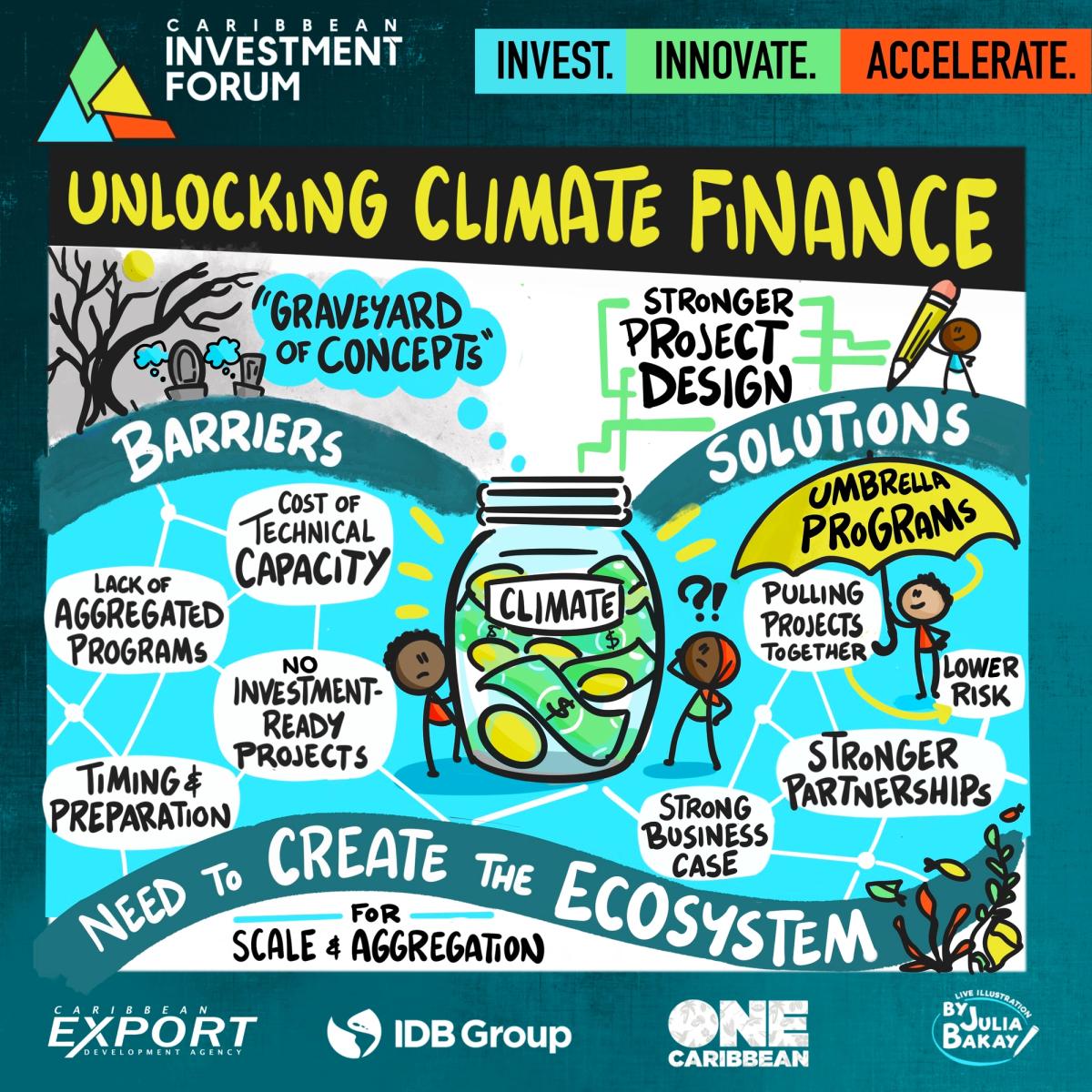
These may include high technology costs, limited technical expertise, insufficient project preparation capacity and the risks associated with introducing unfamiliar technologies.
The Agency's approach builds on its nearly 30 years of experience administering grants and supporting private sector competitiveness, alongside its ongoing work through the Caribbean Investment Forum to develop investment-ready project pipelines.
Importantly, Caribbean Export's GCF accreditation covers grant-based activities. Naut explained that this creates opportunities to work alongside financial institutions and development banks to structure financing solutions that combine grants with other forms of capital.
For Caribbean micro, small and medium-sized enterprises (MSMEs), grants can play a particularly important role in reducing the financial risks associated with adopting new technologies or business practices.
The Agency is developing project concepts for submission through the GCF process, with a focus on demand-driven initiatives, project aggregation and partnerships capable of generating meaningful regional impact.
Avoiding the 'graveyard of concepts'
A recurring challenge identified by the panel was the gap between promising climate ideas and projects that are sufficiently developed to attract financing.
Dr. Colin Young, Executive Director of the Caribbean Community Climate Change Centre, described the problem as a potential "graveyard of concepts" initiatives that never progress because the resources required for project preparation have not been adequately considered.
He explained that preparing a major climate project can cost approximately 3–5% of its total value, covering feasibility studies, environmental and social assessments, technical design and other requirements.
For projects valued at US$25–30 million, preparation costs alone can reach US$1–1.5 million.
These costs, combined with lengthy approval processes and differing regulatory requirements across countries, create significant barriers to implementation.
The solution, Young argued, requires dedicated project preparation resources, stronger technical expertise and more coordinated regional approaches.


Building scale through regional solutions
One of the strongest recommendations was to move beyond developing climate projects individually towards creating aggregated, multi-country investment programmes.
For relatively small Caribbean economies, pooling similar projects can create the scale needed to attract larger financing commitments while reducing transaction costs and spreading risks.
Young identified several opportunities where this approach could work particularly well, including distributed solar energy and storage, hotel energy-efficiency upgrades, water infrastructure improvements and nature-based solutions.
Rather than financing energy-efficiency improvements at individual hotels, for example, regional programmes could aggregate similar investments across multiple properties and countries.
Likewise, pooling opportunities in renewable energy, water conservation or high-integrity carbon projects could create more attractive investment portfolios.
However, successful aggregation requires common standards, credible institutions and greater alignment across national regulatory systems.
Using finance differently to unlock investment
Dr. Donneil Cain, Climate Change Coordinator at the Caribbean Development Bank, reinforced the importance of matching financing instruments to project needs and risk profiles.
Rather than relying solely on traditional lending, development finance institutions can help mobilise private capital through blended finance, guarantees, concessional resources and sustainable financing instruments.
Pooling projects into investment portfolios also creates opportunities to manage risk more effectively and structure financing solutions that attract multiple investors.
The discussion highlighted the importance of using grants strategically—not as permanent sources of business funding, but as catalytic resources that help projects progress towards commercial viability.
This approach was reinforced by Dr. David Bynoe, National Coordinator of the Global Environment Facility Small Grants Programme under UNDP, who emphasised the importance of community-level pilot initiatives.
Drawing on Barbados' renewable energy experience, he explained how technical assistance, supportive policy frameworks and practical demonstrations helped establish viable business models and encouraged investment.
Community-based projects, he argued, can provide the proof of concept needed to attract larger sources of capital.
Supporting businesses through the 'missing middle'
Cheryl Senhouse, Finance Innovation Director at the Caribbean Climate-Smart Accelerator, drew attention to another critical financing gap: the limited support available between early-stage grants and larger commercial investments.
Many Caribbean businesses approach investors before their projects are sufficiently developed, lacking the business models, financial structures or operational readiness needed to secure financing.
The Accelerator has responded by strengthening its project preparation support, including catalytic grant funding, technical assistance and resources that help entrepreneurs become more investment-ready.
Senhouse emphasised the need to build an ecosystem that supports enterprises at different stages of development, allowing them to progress from concepts and pilots towards scalable businesses capable of attracting appropriate financing.
From climate ambition to implementation
The session concluded with a shared call for stronger collaboration among regional institutions, governments, financial partners and businesses.
For Caribbean Export, the immediate priority is to strengthen the pipeline of climate-related projects, invest in preparation and work more closely with partners such as CDB and the CCCCC to make better use of their respective capabilities and accreditations.
The Agency's GCF accreditation provides an important new institutional pathway to advance this work, connecting its private sector development experience with opportunities to mobilise climate-focused grant resources and complementary investment.
Ultimately, the challenge is not simply unlocking climate finance. It is ensuring that those resources reach Caribbean businesses, strengthen competitiveness, generate economic opportunities and build resilience across the region.
The Caribbean has the climate ambition, the ideas and increasingly the institutional tools. The imperative now is to turn them into investment and measurable results.
Watch the full discussion
Hear the perspectives and practical recommendations shared during “The Climate Capital Imperative: Unlocking Climate Finance for Caribbean Growth” at CIF 2026.
The accompanying live illustration by Julia Bakay captures the session's key barriers, solutions and recommendations.
The Caribbean Investment Forum 2026 was organised by the Caribbean Export Development Agency in collaboration with the Government of Barbados and the European Union.