


Global investment patterns are changing. Geopolitical uncertainty, technological innovation, the energy transition and shifting trade relationships are influencing where investors deploy capital and how they assess opportunities.
For the Caribbean, these changes present both a challenge and an opportunity. The region has attractive sectors, strategic geographic advantages and growing interest from international financial institutions. Yet investment flows remain volatile, concentrated in a few economies and heavily influenced by large projects.
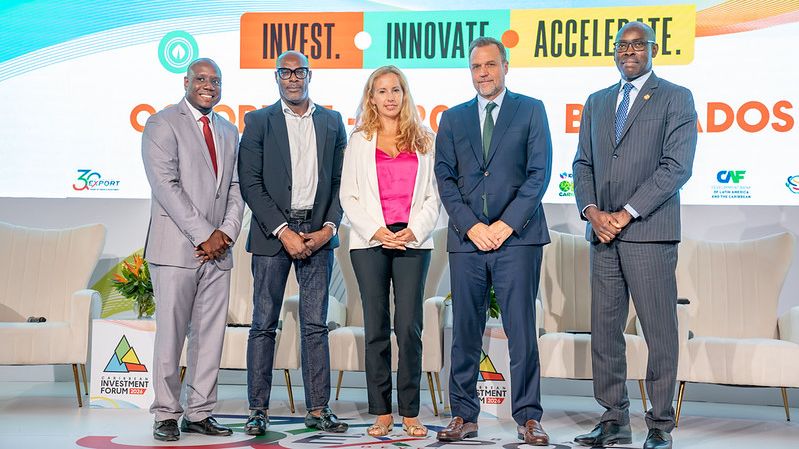
At the Caribbean Investment Forum (CIF) 2026 in Barbados, "The Global Investment Outlook: Where Capital Is Moving Next and Why the Caribbean Must Be Ready" brought together senior representatives from the European Investment Bank (EIB), African Export-Import Bank (Afreximbank), Inter-American Development Bank (IDB) and Sygnus Capital to explore how the region can position itself more effectively in a changing investment landscape.
Moderated by Wayne Elliott, Head of Technical Programmes at Caribbean Export, the discussion examined not simply where capital is moving, but what the Caribbean must do to attract it.
New investment corridors are creating opportunities
One of the strongest themes emerging from the discussion was the diversification of global investment relationships.
Okechukwu Ihejirika, Acting Chief Operating Officer of Afreximbank's Caribbean Office, highlighted the growing importance of South-South cooperation, particularly stronger trade and investment connections between Africa, the Caribbean and Latin America.
As geopolitical tensions and protectionist policies reshape established trade relationships, alternative investment corridors are becoming increasingly important.
For Afreximbank, the opportunity extends beyond financing transactions between individual countries. It is about developing value chains, improving logistics and connectivity, and creating commercial partnerships that allow businesses to expand into new markets.
Ihejirika emphasised that Caribbean enterprises seeking to enter African markets should consider partnerships with local businesses that can provide market knowledge, distribution networks and opportunities for scale.
He also stressed the importance of collaboration among development banks and other financial institutions to create blended financing solutions and reduce investment risks.
From the European perspective, Maria Rojas Gonzalez of the European Investment Bank explained that financing now extends across multiple levels of the financial system, including sovereign lending, guarantees, financing through regional development banks, corporate loans, public-private partnerships and equity investment.
However, she identified a challenge that goes beyond the availability of financing: the Caribbean must improve its visibility within the global investment landscape.
The Caribbean's competitive advantage is not its size
Fabrizio Opertti, Manager of the Productivity, Trade and Innovation Sector at the IDB, challenged the tendency to view the Caribbean's small markets primarily as a disadvantage.
"The Caribbean opportunity is not about scale. It's about quality. It's about niches. It's about resilience."
He identified four areas where the region has opportunities to differentiate itself:
2. Sustainable tourism: Beyond attracting visitors, the opportunity lies in strengthening tourism's connections with local agriculture, cultural industries, professional services and other Caribbean businesses.
3. Food security and agribusiness: Greater investment in agricultural production, innovation and stronger supply chains could help reduce import dependence while creating new commercial opportunities, particularly through linkages with hospitality.
4. The blue and green economy: The Caribbean's natural resources and environmental assets provide opportunities for innovation, research, specialised services and sustainable investment.
Across all four areas, however, Opertti stressed the importance of improving regional connectivity.
High transportation and logistics costs continue to weaken competitiveness, making investment in ports, digital trade systems, transportation and related infrastructure essential.
The region's opportunity, he argued, is already well understood. What remains insufficient is execution.


Investment readiness remains a critical barrier
While investment opportunities are plentiful, Berisford Grey, Co-Founder and CEO of Sygnus Capital, provided a practical perspective on why promising projects frequently struggle to secure financing.
Large infrastructure projects backed by established sponsors generally arrive with detailed feasibility studies, clearly identified risks, contractual arrangements and financing structures.
Smaller entrepreneurial ventures and medium-sized businesses often face a different reality.
Incomplete feasibility studies, weak governance arrangements, unaudited financial statements and insufficient risk assessments can prevent investors from making financing decisions, even when they see commercial potential.
Grey explained that investors need confidence not only in the business opportunity but also in the systems supporting its execution.
He highlighted the importance of technical assistance and project preparation support, citing the Caribbean Resilience Fund's approach to helping enterprises strengthen their capabilities and become investment-ready.
Rojas Gonzalez reinforced this point, explaining that successful investments, particularly public-private partnerships, depend on careful preparation, predictable contractual arrangements and risks that can be properly assessed and priced.
For the Caribbean, improving investment readiness must therefore extend beyond preparing attractive proposals. It requires stronger business governance, technical capacity and sustained institutional support to bring projects to the point where investors can confidently commit capital.
Unlocking capital within the Caribbean
An important dimension of the discussion was the opportunity to mobilise more of the capital already available within the region.
Grey highlighted the fragmented regulatory environment governing pension fund investments across Caribbean economies.
Although pension funds represent significant pools of long-term capital, restrictions and differences in national regulations can make it difficult for these funds to invest across regional markets.
Greater regulatory coordination could help channel more Caribbean savings into infrastructure, business expansion and other productive investments.
He also encouraged policymakers to learn from sectors that have successfully attracted international capital, particularly tourism.
The investment structures, incentives, protections and opportunities for investors to realise returns that have supported tourism investment could offer useful lessons for sectors such as climate-smart agriculture, logistics and technology.
The wider message was that regional competitiveness depends not only on attracting new sources of foreign capital, but also on making existing financial resources more accessible and productive.
From dialogue to transactions
As the discussion concluded, the panellists converged on one overriding priority: implementation.
Ihejirika called for greater attention to measuring the outcomes of investment forums, partnerships and institutional commitments, ensuring that discussions lead to projects financed and businesses supported.
Opertti similarly challenged development institutions to move beyond repeatedly diagnosing the region's challenges and focus more directly on delivering practical solutions.
For Rojas Gonzalez, the emphasis was on collaboration among institutions with the financing tools and technical capabilities to bring projects to fruition.
Grey added that the Caribbean must strengthen its development institutions, improve the movement of capital across regional markets and preserve the political stability that remains an important consideration for international investors.
Collectively, their contributions pointed towards a more coordinated investment ecosystem—one in which governments, development banks, private investors and businesses work together to identify opportunities, prepare projects and complete transactions.
For Caribbean Export, this is central to the role of the Caribbean Investment Forum: moving beyond conversations about the region's potential to creating meaningful connections between capital and investment-ready opportunities.
The region's competitive advantages are real, but they will not automatically translate into increased investment.
The Caribbean's next chapter will depend on its ability to move from investment potential to investment performance—from dialogue to deals.
Watch the full discussion
Explore the perspectives shared during "The Global Investment Outlook: Where Capital Is Moving Next and Why the Caribbean Must Be Ready" at CIF 2026.
Moderator: Wayne Elliott, Caribbean Export Development Agency
Panellists:
The accompanying live illustration by Julia Bakay captures the session's key messages on investment opportunities, collaboration, project preparation, regional connectivity and the need to translate investment potential into action.
The Caribbean Investment Forum 2026 was organised by the Caribbean Export Development Agency in collaboration with the Government of Barbados and the European Union.